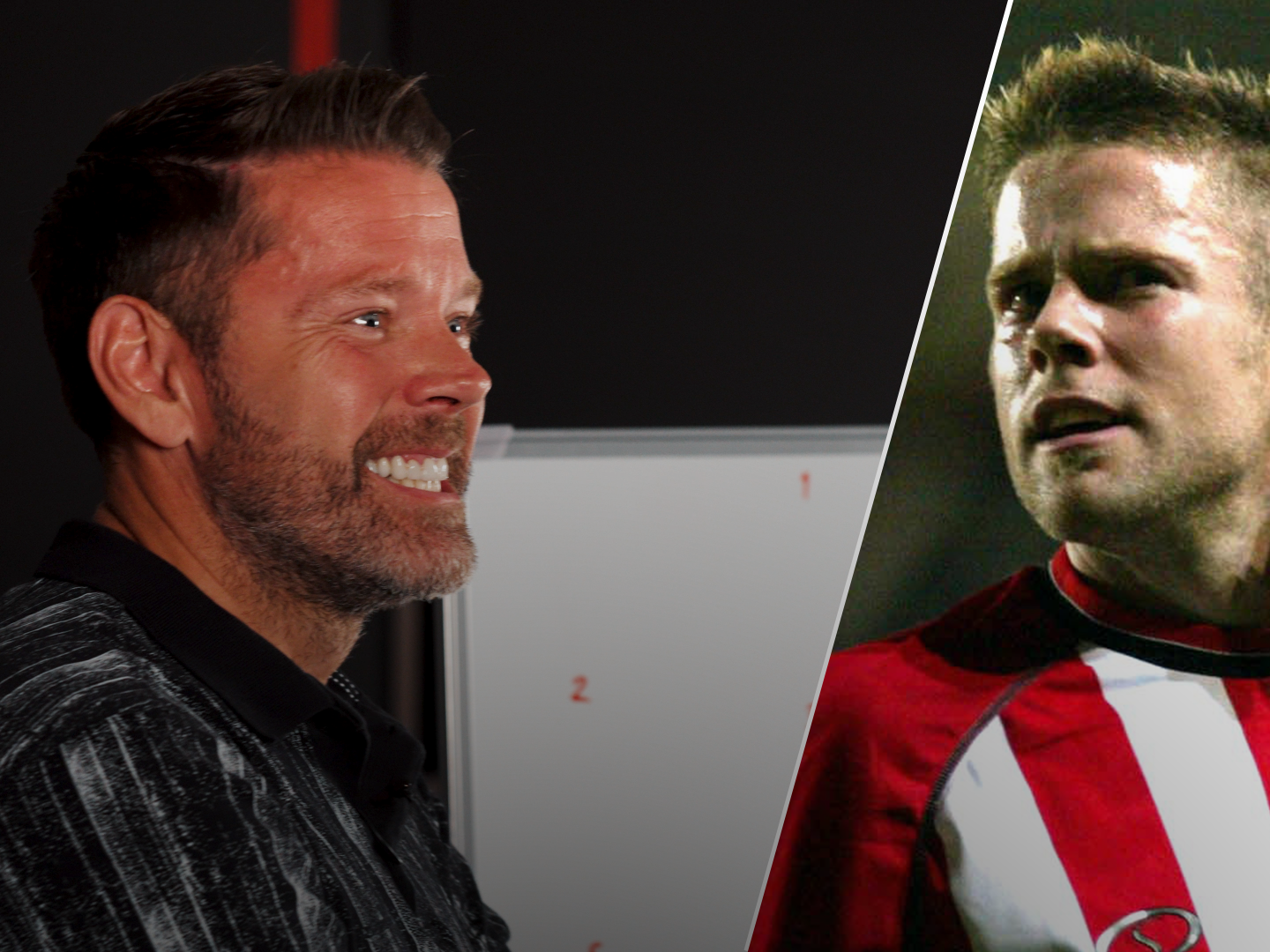
Perfectly Imperfect: The story behind Steve Moran's timeless classic
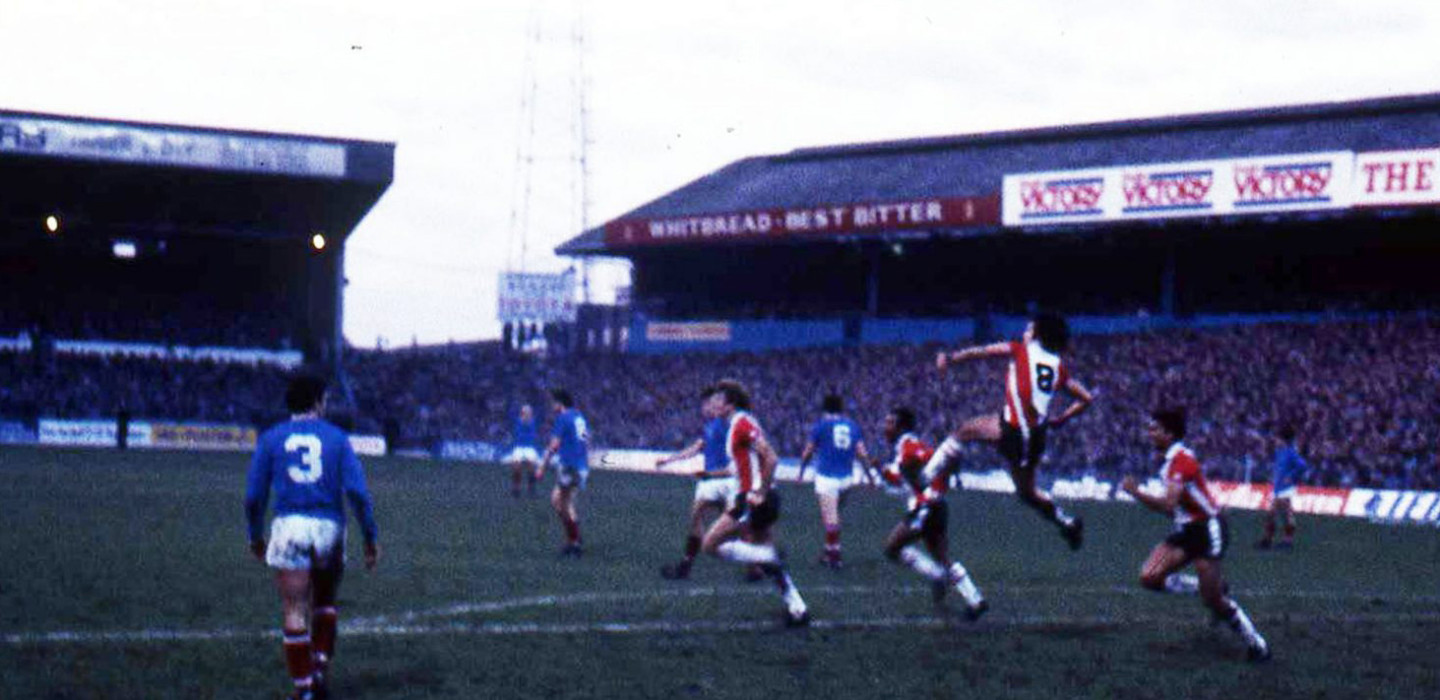
“The winning goal was all wrong.”
More than 40 years have passed since Steve Moran struck Saints’ most iconic south coast derby goal, but the scorer still remembers every detail of the move as vividly as ever.
“Frank Worthington, who was totally left-footed, was in the left-channel position and hooked a ball with his right foot – his wrong foot – into the right-channel position where David Armstrong was,” Moran recalls.
“God knows why he was there, because he was a left-sided midfield player, but it came to him to cross the ball with his wrong foot, which was his right foot. And then the ball was coming across goal towards me.
“The only way I was going to be able to take it and hit the target was to take it on the volley on my wrong foot, my left foot. Alan Knight, who was the goalkeeper for Portsmouth, did get a very, very good strong hand to it, but obviously not strong enough.”
Like so many of Southampton’s greatest moments, there was something perfectly imperfect about Moran’s goal for the ages; a goal still lauded by Saints fans of every generation, not just those who were alive in 1984, or, better still, there to witness it first-hand from Fratton Park’s Milton End terrace.
Matt Le Tissier, whose catalogue of goals is surely the most spectacular of any player in Premier League history, doesn’t like the fact that the finishing touch to his sublime solo strike against Newcastle, often voted by Saints fans as his best goal of all, was “a bit of a bobble”.
When Bobby Stokes, a man from Portsmouth, won the FA Cup for Southampton in ’76, debate rumbled on that he was offside, and that a cleaner connection with his less-favoured left foot would not have deceived Manchester United goalkeeper Alex Stepney. “He (Stokes) didn’t catch it very well but the bad one beat him (Stepney),” co-commentator Jack Charlton remarked.
When Saints toppled Inter Milan in the club’s finest result of the St Mary’s era, the winning goal was actually scored by an Inter player, Yūto Nagatomo, as the perfectly imperfect trend continued into the 21st century.
Back in ’84, Moran was the man. The 1983/84 campaign would prove to be the most prolific of his career, scoring 25 goals in all competitions, including the moment that booked Saints’ place in the FA Cup fifth round at the expense of their bitter rivals.
Only Ian Rush and Gary Lineker, two of the greatest British goalscorers ever, eclipsed Moran’s tally of 21 in the top flight that season, as a brilliant Saints side finished runners-up behind Liverpool.
Few knew more about the south coast derby than the man who decided it that day. Though born in Croydon, Moran moved south to Warsash at the age of five following his father’s passing.
He played local football for Sarisbury Sparks, where he was first spotted by Saints boss Lawrie McMenemy, playing on a wet pitch with no studs.
“I was slipping and sliding all over the place because I only had a pair of moulded boots,” Moran picks up the story. “My mum couldn’t really afford expensive boots, so he (McMenemy) said to me at half time, ‘you score a hat-trick in the second half and I’ll buy you a new pair of boots’. It’s a true story, which he likes to tell, that I scored the quickest hat-trick in history at the start of the second half!
“He was true to his word, and said ‘get yourself to Toomer’s sports shop’, which was local to the area at the time, ‘and there will be a pair of boots’. Sure enough, that’s what happened.”
A moment etched in Southampton history: Moran gives the travelling Saints fans a memory to last a lifetime
Moran signed schoolboy forms with Saints at 14, but only after training with Portsmouth, the closest professional club to Price’s School where he was educated in Fareham.
When his school football team, predominantly Pompey supporters, won the Hampshire Cup, thanks in no small part to Moran’s scoring instincts, Portsmouth invited the whole team to train on a Thursday evening.
“The majority of my friends and the lads at school, being at Fareham, were Portsmouth fans, so I lived the rivalry from being at school right through to the present day. I supported Southampton, so I was in the minority,” Moran says.
“I knew the rivalry was as bitter as you could get. They talk about derby games, the likes of Leeds and Man United, the Glasgow derby and the London derbies, but you’d be hard pushed to find something as sinister as the Portsmouth-Southampton one.
“For some reason they just have this history of hating each other, and it just rubbed off into the football and everyday life.”
Moran remembers attending his first derby and standing with the home fans at Fratton Park as he watched a young Steve Williams, his future teammate, make his Saints debut in April 1976, just 25 days before Portsmouth-born Stokes would win Saints the cup.
Half a century has passed since Williams’s debut. Saints’ 1-0 win that day, courtesy of Mick Channon’s 89th-minute goal, remains the club’s last league victory on enemy territory.
“I was there in the crowd and got recognised by a few people and was basically trying to hide away. That was the last game (between the clubs) before the cup tie in ’84. It wasn’t a regular occurrence, which made the game even more important for the sets of fans, and for the bragging rights.”
After eight derbyless years, Moran, who played 229 games for the club in all, would play against Portsmouth in a Saints shirt for the one and only time.
Steve Williams (left) and Moran board the team coach to Fratton Park in 1984
In total he scored 99 goals for Southampton – 100, he argues, but David Armstrong wrongly claimed one at Sunderland that Moran remains adamant was his, with no TV footage to back him up – but none quite as precious as the one that sent one end of Fratton Park into a frenzy.
He modestly points out that Alan Biley should have been the hero, not himself, but the Portsmouth man blazed a big chance over the bar shortly before Moran’s moment arrived.
“It was time added on because our left-back, Mark ‘Psycho’ Dennis, had been hit on the head by a coin,” Moran recalls.
“He used to go down to get treatment just for the sake of it, so he was a bit of a cry wolf sometimes! But he went down, he’d been hit by this coin, and it served the Pompey fans right, because in the time added on for him getting the treatment, we scored the winner.”
Williams, closely followed by Moran, leads out the Saints side for the first south coast derby since his triumphant debut eight years prior
After the “all wrong” build-up resulted in Armstrong’s floated cross to the far post, Moran had just enough time – not only to set himself for the finish on his weaker side, but to consider the ramifications of scoring.
“That was a result of hours and hours and hours of practising my finishing in the gym with the Southampton coaching staff,” he says. “My left foot would never be as good as my right foot, but it was so that my left foot would be adequate to be able to finish chances like this one.
“The main thing I thought of as the ball was coming across, because this was probably the only chance I’d had in the game, was ‘this is my chance’.
“I’d thought, earlier in the game, ‘if somebody scores here, there’s going to be mayhem’. I realised, very, very soon after I had scored, obviously we all went berserk, but it was almost like, ‘what have I done here?’
“It was very much ‘let’s get this game over and get down the tunnel’. I’m sure I was stood by the tunnel to get off the pitch, because I could foresee it being not a very happy atmosphere with it all happening so late, with their disappointment.”
Moran in action at The Dell in a game against Tottenham in October ‘84
Nowadays, the local hero laments the lack of homegrown players compared to the ’84 line-up, half of whom had come through Saints’ youth ranks – an impressive feat for a team widely considered the club’s best ever.
The only thing missing was a major honour.
“We were convinced our name was on the cup that season because of the way the draw had gone,” Moran reflects. In another example of perfect imperfection, Saints were drawn away from home in every round all the way to the semi-finals, which were to be played at a neutral ground.
Moran scored four FA Cup goals en route to Highbury, where Saints would face Everton for a place in the final. In keeping with previous draws, it was the toughest possible outcome, with top-flight underdogs Watford and Plymouth Argyle, struggling in the Third Division, making up the last four. It felt like whoever won the marquee semi-final would lift the trophy.
And so it proved. Unfortunately for Saints, a headed goal from Adrian Heath late in extra time sent Everton to Wembley, where Watford were soundly beaten.
But memories of Moran at the Milton End will live on forever, passed from one generation of Saints fans to the next, perhaps just as fondly as if he’d repeated Stokes’s Wembley winner.
This interview was originally published inside SAINTS, the club’s matchday programme, for this season’s home game against Portsmouth, the first south coast derby at St Mary’s in 13 years.
Photos from The Holley Collection.