Commemorating the 110th anniversary of the Battle of Jutland
In the space, hereabouts, of 32 days – from 31st May to 1st July – we commemorate the 110th anniversaries of two momentous battles: Jutland and the Somme, respectively. Club historian David Bull here identifies some Saints connections.
The Royal Navy had gone into the First World War ruling the high seas. Its superior numbers over the Imperial German Navy meant that its Grand Fleet could be harboured, unthreatened, in the Orkney Islands at Scapa Flow, whence its patrols in the North Sea would normally be sufficient to keep Germany’s High Seas Fleet at home – until 31st May 1916, that is, when the latter ventured out for a provocative nibble that resulted in a major engagement off the coast of Jutland in Denmark.
The club had a ready war-time supply of footballing sailors on hand at the Navy’s in-shore establishments in Portsmouth Harbour, notably HMS Excellent or a version of HMS Victory. Orkney, on the other hand, was a long way from The Dell. So, in stark contrast with our upcoming commemoration of the Battle of the Somme, involving 17 Southampton footballers, our Battle of Jutland story features just the one seafaring Saint.
That said, I deem it appropriate to introduce this commemoration by explaining how the officer-in-charge at Jutland had a vicarious connection to the club. Admiral Sir John Jellicoe, the Commander of the Grand Fleet, had been born in Southampton to a naval family in 1859. I have been pleased, as I hope you might be, to discover that he appeared in an Ogden cigarette card, footballing examples of which you’ll have come across in histories of the club, as reproduced from Duncan Holley’s enviable collection.
Likewise, you’ll perhaps have read that young Jellicoe was a pupil at Banister Court, an independent school just up the road from The Dell, albeit for a year only, between his dame school in Southampton and his Sussex boarding school. That was long enough for him to make his mark at rugby, while the local historian, A.G.K Leonard, writing more than 100 years later, would rate him the school’s ‘most distinguished old boy’.
That accolade might come as a surprise to Saints fans accustomed to the club historians acclaiming the achievements of Charles Miller, a native of São Paulo who arrived as a Banister Court boarder in 1884. Having played, even as a schoolboy, for the Saints in a few charity matches and several friendlies, he then took the game of football to Brazil in 1894. That remarkable claim to fame notwithstanding, let’s leave it there and note that Banister Court was the predominant Southampton school in producing First World War officers. One of them, Cecil Christmas, will be a leading figure in our commemoration of the Somme, come 1st July.
Meanwhile, we can turn, with the aid of his death notice in the local press below, to Charles Duncan. Born in Newcastle in 1888, he would spend so much time in Portsmouth that when he was buried there in April 1934, he would be described as a ‘native’. Although that notice headlined his presence at Jutland, it devoted more space to his achievements as a sporting all-rounder: as an inter-service boxer; as a repeated winner of bayonet competitions; and as having made one first-team appearance for the Saints – on Good Friday 1917 when, home from the sea, he played in a 4-0 defeat at Clapton Orient.
Having joined the Navy in 1907, he had become a gunner, in June 1913, with the Royal Marine Artillery on HMS Conqueror, one of the four-strong fleet of Orion Classships built in the pre-war naval arms race with Germany. Part of the Grand Fleet that had failed to intercept the German ships that bombarded Scarborough, Hartlepool and Whitby in December 1914, she was scouting in the North Sea on 31 May 1916, when enemy vessels were spotted.
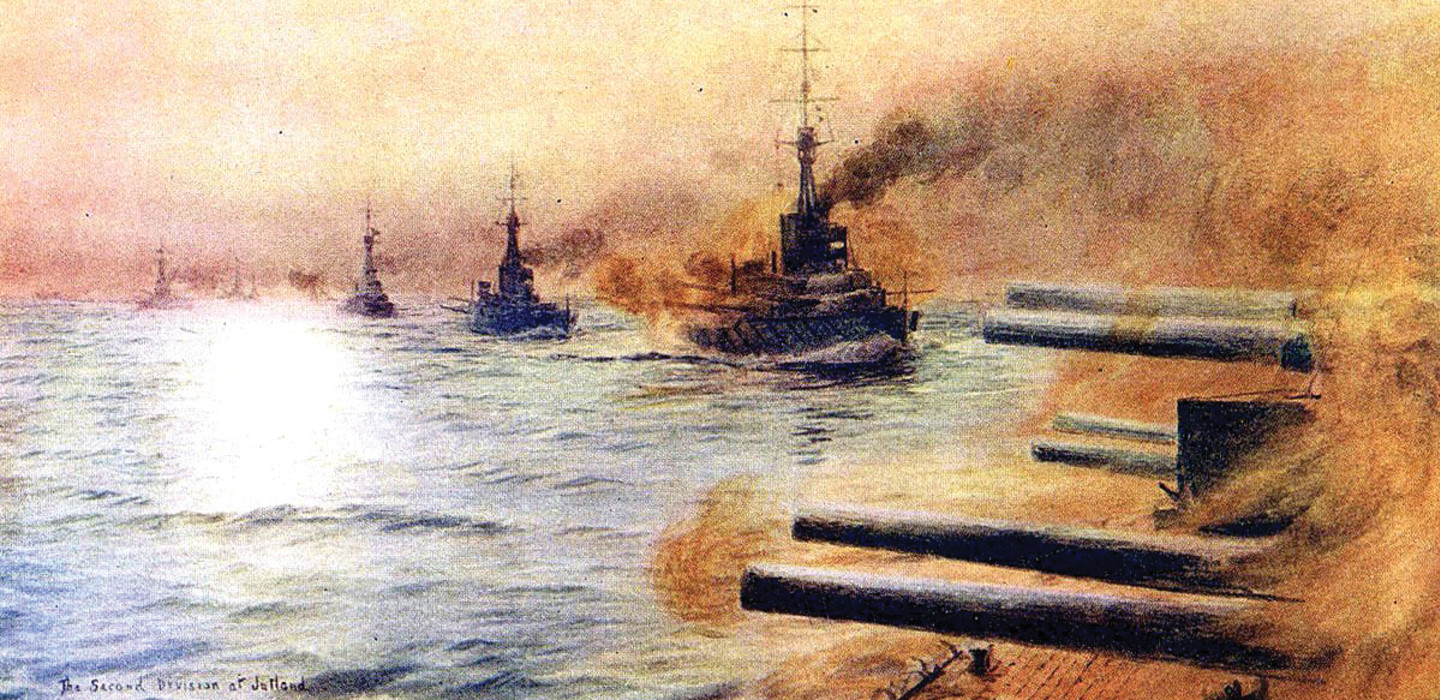
The four Orion Class ships, seen at the top of this article, were among the 250 that exchanged fire over a period of 36 hours, during which HMS Conqueror fired 57 rounds while suffering no damage from enemy shells. She was lucky: the British lost 14 ships to Germany’s 11 and 6,000-odd men to the enemy’s 2,000-odd. Accounts vary as to exact figures, but the Germans certainly had a winning score. On the other hand, they were the ones who retreated, never to venture out again, as they concentrated, to sinister effect, on U-boat warfare.
Gunner Duncan would see out the War on the Conqueror. Then he would sign amateur forms for the Saints but be limited to one goal-scoring appearance for the Reserves in 1919/20. Quitting the seas in 1920, he would spend his final eight years of service in the Marines’ Portsmouth barracks.
The above story is excerpted, with historical assistance from Dave Juson, from the club historians’ Saints in the Great War, available online or in the Saints Store at St Mary's.
The excerpted commemoration of the Battle of the Somme will be posted here on 1st July.
The picture at the top of this article shows HMS Conqueror (second left) at Jutland, with her sister ships of the Orion Class.